ESCO Lifesciences
Class I Biological Safety Cabinet
A Class I Biosafety cabinet protects the operator and the environment from exposure to biohazards.

A world-leading life science company with a diversified portfolio and sales in over 100 countries. As a manufacturer of laboratory and biopharma equipment, and IVF medical devices, Esco offers tailored solutions that fit the needs of laboratories in various industries. It contributes to meet the challenges of the 21st century with a diverse range of business units. The company continuously innovates its products to help the clinical and industrial laboratories achieve successful conclusions.
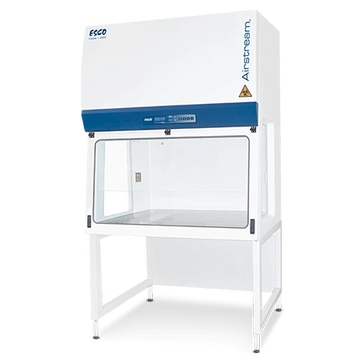
Biological Safety Cabinet
Also known as a Biosafety Cabinet, is mainly used for handling pathogenic biological samples or for applications that require a sterile work zone. A biological safety cabinet creates inflow and downflow of air that provides operator protection. The downflow air passes through an ULPA/HEPA filter and creates an ISO Class 3 work zone to protect samples from the risk of cross-contamination. The air exhausted also passes through an ULPA/HEPA filter.

Class I Biological Safety Cabinet
The Class I cabinet has the most basic and rudimentary design of all biological safety cabinetry available today. A stream of inward air moving into the cabinet contains aerosols generated during microbiological manipulations. It then passes through a filtration system that traps all airborne particles and contaminants. Finally, clean and decontaminated air is exhausted from the cabinet. The filtration system usually consists of a pre-filter and a HEPA (High Efficiency Particulate Air) filter.
Class II Biological Safety Cabinet
The Class II Type A2 biological safety cabinet is the most common Class II cabinet.

Class II Type A2
The Class II Type A2 biological safety cabinet is the most common Class II cabinet. It has a plenum from which 30% of air is exhausted, and 70% re-circulated to the work area as the downflow.
Stated from NSF/ ANSI 49:2010, both the Class II Type A1 and Type A2 must have the positively-pressurized contaminated plenum to be surrounded by negative pressure. In case there is a leakage on the positive plenum, the leaking aerosol will be pulled by the negative pressure back to the positive plenum.

Class II Type B1
The Class II Type B1 biological safety cabinet has a common plenum from which 70% of air is exhausted, and 30% re-circulated to the work area as the downflow. This cabinet also has a dedicated exhaust feature that eliminates re-circulation when work is performed towards the back within the interior of the cabinet. Toxic chemicals employed as an adjunct to microbiological processes should only be allowed if they do not interfere with work when re-circulated in the downflow.

Class II Type B2
The Class II Type B2 biosafety cabinets are suitable for work with toxic chemicals employed as an adjunct to microbiological processes under all circumstances since no re-circulation occurs. In theory, Type B2 biological safety cabinets may be considered as the safest of all Class II BSCs since the total exhaust feature acts as a fail-safe in the event that the downflow and / or exhaust HEPA filtration systems cease to function normally. Class II Type B2 biosafety cabinets require large spaces

Labculture® G4 Class II Type A2 Biological Safety Cabinet
- Available in three sash opening models: 8”, 10”, &12”
- Dimmable LED lighting system
- Centurion touchscreen controller
- Standby height that activates standby mode sustaining ISO Class 3 work zone as the fan runs at half speed
- USB port to relay operational parameters to Building Management System (BMS)
- Remote Modbus
- Default cable port
- Optional 21 CFR Compliance
- Stainless steel interior
- Single-piece work tray
- Equipped with DC ECM blower for up to 70% energy savings
- Low power consumption
- Width: 3ft, 4ft, 5ft, 6ft
%20G4%20Class%20II%20Biolog.JPG/:/cr=t:3.5%25,l:0%25,w:100%25,h:93%25/rs=w:360,h:360,cg:true)
Labculture® Plus (S-series) G4 Class II Biological Safety Cabinet
- 200 mm (8”) sash opening
- Dimmable LED lighting system
- Centurion touchscreen controller
- Tiltable sash for easy glass cleaning
- Standby height that activates standby mode sustaining ISO Class 3 work zone as the fan runs at half speed
- USB port to relay operational parameters to Building Management System (BMS)
- Remote Modbus
- Default cable port
- Optional 21 CFR Compliance
- S-Series: Single-piece work tray, stainless steel sidewalls
- Motorized window
- Equipped with DC ECM blower for up to 70% energy savings
%20G4%20Class%20II%20Biolog.JPG/:/cr=t:2.29%25,l:0%25,w:100%25,h:95.41%25/rs=w:360,h:360,cg:true)
Labculture® Plus (E-Series) G4 Class II Biological Safety Cabinet
- 200 mm (8”) sash opening
- Dimmable LED lighting system
- Centurion touchscreen controller
- Tiltable sash for easy glass cleaning
- Standby height that activates standby mode sustaining ISO Class 3 work zone as the fan runs at half speed
- USB port to relay operational parameters to Building Management System (BMS)
- Remote Modbus
- Default cable port
- Optional 21 CFR Compliance
- S-Series: Single-piece work tray, stainless steel sidewalls
- Motorized window
- Equipped with DC ECM blower for up to 70% energy savings
%20G4%20Class%20II%20Biological%20.JPG/:/cr=t:0%25,l:1.74%25,w:96.53%25,h:100%25/rs=w:360,h:360,cg:true)
Labculture® (G-series) G4 Class II Biological Safety Cabinet
- 200 mm sash opening
- Dimmable LED lighting system
- Centurion touchscreen controller
- Tiltable sash for easy glass cleaning
- Standby height that activates standby mode sustaining ISO Class 3 work zone as the fan runs at half speed
- USB port to relay operational parameters to Building Management System (BMS)
- Remote Modbus
- Default cable port
- 21 CFR part 11 as standard feature
- Full SS316L working area, with single piece work tray
- Single sheet internal walls with smooth edges for easy cleaning
- Motorized window

Labculture® G4 Class II Type B2 (Total Exhaust) Biological Safety Cabinet,
- 200 mm sash opening
- Dimmable LED lighting system
- Centurion touchscreen controller
- Tiltable sash for easy glass cleaning
- Standby height that activates standby mode sustaining ISO Class 3 work zone as the fan runs at half speed
- USB port to relay operational parameters to Building Management System (BMS)
- Remote Modbus
- Default cable port
- 21 CFR part 11 as standard feature
- Full SS316L working area, with single piece work tray
- Single sheet internal walls with smooth edges for easy cleaning
- Motorized window

Labculture® G4 Class II Type B2 (Total Exhaust) Biological Safety Cabinet
- Dimmable LED lighting system
- Centurion touchscreen controller
- USB port to relay operational parameters to Building Management System (BMS)
- Remote Modbus
- Default cable port
- Optional 21 CFR Compliance
- Stainless steel interior
- Single-piece work tray
- Equipped with DC ECM blower for up to 70% energy savings
- Low power consumption
- Available width sizes: 3 ft, 4 ft, 5 ft, and 6 ft
Esco Lifesciences
Class III Biological Safety Cabinet
The Class III biological safety cabinet provides an absolute level of safety, which cannot be attained with Class I and Class II cabinets.

Class III Biological Safety Cabinet
Class III biological safety cabinets are suitable for work with microbiological agents assigned to biosafety levels 1, 2, 3 and 4. They are frequently specified for work involving the most lethal biological hazards.
Work is performed through glove ports in the front of the cabinet. During routine operation, negative pressure relative to the ambient environment is maintained within the biosafety cabinet. This provides an additional fail-safe mechanism in case physical containment is compromised.
Airstream® Class III Biological Safety Cabinet
- Dual exhaust ULPA Filter
- Negative pressure work zone
- Monitored by a Magnehelic™ gauge
- Sentinel™ Silver Microprocessor controller
- Single piece, leak-tested Neoprene™ gauntlets
- Ergonomically angled front
- Available sizes: 4 ft, 5 ft, and 6 ft
Containment Barrier Isolators (CBI)
- Double-filtered exhaust air via ULPA filters
- Single-piece and leak-tested glove assemblies for maximum protection
- Fully welded stainless steel 316L (internal chambers) and 304 (external housing)
- Suitable for handling Biosafety Levels 1 to 4
- Available sizes: 4ft, 5ft, and 6ft.
Streamline® Containment Isolator - Class III
- ISO Class 3 work zone
- Superior operator protection for cytotoxic drug handling
- Fast purging time
- Motorized height stand
- Suitable for cytotoxic drug handling
- Available sizes: 4ft and 6ft
Turbulent Flow Aseptic Isolator (TFAI)™
- Automated airflow and pressure control
- LED lamps for superior illumination
- Oval-shaped glove ports to maximize arm movement
- Hydraulic support frame legs for operator comfort
- Suitable for hazardous or non-hazardous drug handling
- Available sizes: 4ft, 5ft, and 6ft.
Must-have features to consider:
- Dual exhaust ULPA filters provide better protection than single-stage designs
- User-friendly control system
- Single piece, leak-tested Neoprene™ gauntlets to guarantee max protection.
- Integrated pass-through with interlocking doors permits materials transfer without risk of contamination.
- Angled cabinet front ensures a comfort
- Magnehelic gauge mounted on the rear of work zone for easy monitoring
- Audible & visual alarms to notify user of unsafe condition
- Isocide™ powder coat that inhibits microbial growth